[Sustain] Important! Joint Transpo/Sustainability Working Group, Thu June 26, 6:30pm

Hi all, VERY important stuff is happening on transportation, utilities and energy in San Francisco, and we really need to meet. This Thursday June 26, 6:30pm, SFGP Office Proposed Agenda 1) Imminent Muni Fare Hikes 2) Mayor's Ballot Measure Removing Board of Supes Oversight Of Transit 3) Nov Ballot Measure For 100% Green Public Power! 4) PREPARING FOR AUGUST APPOINTMENTS TO THE SFPUC 5) Peak Oil Report? (Jeanne) 6) Water Report? (Mato Ska) 7) Quick Update On Community Choice & Power Plants -- "I am not a liberator. Liberators do not exist. The people liberate themselves." – Che Guevara

I'll be there. We should also discuss Jake's proposed MTA amendment, which is attached. JMC -- John-Marc Chandonia (jmc@sfgreens.org) http://sfgreens.org/
It was tabled in the last Rules committee. John-Marc Chandonia wrote:
I'll be there. We should also discuss Jake's proposed MTA amendment, which is attached.
JMC
-- "I am not a liberator. Liberators do not exist. The people liberate themselves." – Che Guevara

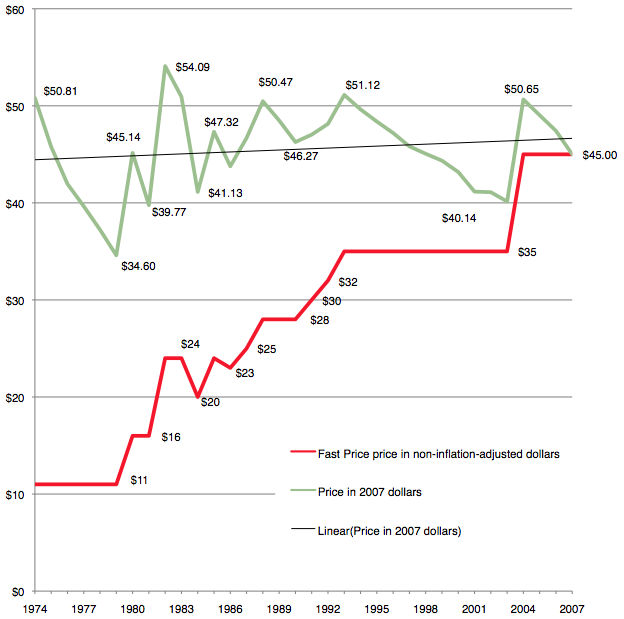
I can't attend this meeting because it's my family night, but I have these comments: 1. The proposed fare hikes are for July 2009, not sooner. That's not imminent. The price of parking and the price of parking violations will rise sooner than fares. And single ride fares will not rise one penny. Really low-income folks who cannot afford the full cost of a monthly pass and therefore pay the single ride fare will be affected by this increase only by experiencing better service. Other really low- income folks who scrape together $45 will benefit from an expanded low- income fast pass discount which is part of the deal with the MTA. At $55, the monthly pass will be ... ... an appropriate amount relative to the single ride fare (about 37 times -- which is the discount for a monthly pass that is unlikely to cause people to switch to paying the single ride fare and thereby slow the system down and discourage ridership). ... a great deal cheaper than most comparable transit systems (NYC=81, AC Transit = 70 or 116, LA=75, for examples), and ... at the high end of its historical price in constant dollars (see the attached chart), but less than its peak of $54.09 in 2007 dollars (which is at least $57 in 2009 dollars). Local, urban transit should be free, but paid for by taxing the rich. Until we figure that out, appropriate fare increases to provide the funding necessary to provide reliable transit service should be supported, especially when those fare increases are not likely to discourage ridership and come after increases to car costs. I would respect a principled decision by the SFGP to oppose any and all fare increases, including "reasonable" ones, but I strongly believe this is a reasonable fare increase and should be supported. 2. I don't have much to say in writing about the mayor's proposed ballot measure. I'm happy to talk with anyone personally about it. I will say this: the SFCTA is one of the best functioning agencies in the city. And, I'll forward separately an email I wrote much earlier about the two agencies, for your edification. Have fun! Dave On Jun 24, 2008, at 7:27 AM, Eric Brooks wrote:
Hi all,
VERY important stuff is happening on transportation, utilities and energy in San Francisco, and we really need to meet.
This Thursday June 26, 6:30pm, SFGP Office
Proposed Agenda
1) Imminent Muni Fare Hikes 2) Mayor's Ballot Measure Removing Board of Supes Oversight Of Transit 3) Nov Ballot Measure For 100% Green Public Power! 4) PREPARING FOR AUGUST APPOINTMENTS TO THE SFPUC 5) Peak Oil Report? (Jeanne) 6) Water Report? (Mato Ska) 7) Quick Update On Community Choice & Power Plants
-- "I am not a liberator. Liberators do not exist. The people liberate themselves." – Che Guevara
_______________________________________________ San Francisco Green Party Active Members List To unsubscribe or edit your options, go here: https://list.sfgreens.org/cgi-bin/mailman/listinfo/active
Here's the email I promised to send earlier, on the TA and MTA. I originally sent if Feb 14.
4. Understanding the distinction between the SFCTA and the SFMTA.
Nat Ford, the SFMTA’s executive director, made the news this week with a call for a merger of his agency and the County Transportation Authority. The articles, here and here, generated a great deal of comments. For your benefit, here’s a little history of the two agencies and some insight into how they work together, or not.
The San Francisco County Transportation Authority (SFCTA) was established in 1989 to administer San Francisco’s half-cent sales tax for transportation. By state law, a Commission charged with administering a local sales tax must consist of elected officials. The SFCTA’s Board is the same as the Board of Supervisors; Jake McGoldrick is its President. In 1990, it was also designated by the state to be the county’s congestion management agency, and it also administers funds generated by the Bay Area Air Quality Management District. It’s considered by many to be one of the most nimble and effective city agencies. Its small staff, led by Executive Director Jose Luis Moscovich, is exempt from civil service regulations that govern most other city agencies.
The San Francisco Municipal Transportation Agency (SFMTA), on the other hand, is a huge agency. Created by Proposition E in 2000 as a merger of the Municipal Railway and the Department of Parking & Traffic, the SFMTA is responsible for transit (many kinds of buses, trains, cable cars, and paratransit), traffic (cars and trucks), bicycling, walking, and parking (public garages, metered parking, neighborhood parking permits). It has enforcement powers to cite illegal parking, fare evasion. It administers the camera enforcement program, with the cooperation of the police department, catching red light runners and illegal parking. Its transit system, our beloved Muni, carries about 700,000 trips every day, more than any other agency in the Bay Area and with one of the lowest subsidies per trip in the Bay Area.
The SFMTA is a unique beast. No other agency near its size incorporates a department of transportation and transit system in a single agency. While most departments of transportation are wholly subsidiary to their political leadership, most transit agencies are wholly independent. The SFMTA is a hybrid: it makes transit, traffic, and parking decisions independently of political interference, but the Mayor nominates its Commissioners, its budget may be rejected by the Board of Supervisors (with a supermajority of seven votes). All but 3% of the MTA's roughtly 5,000 employees are subject to the city’s civil service system.
There are many areas where better cooperation between the agencies would help. For example, while the SFCTA is planning bus rapid transit on Geary and Van Ness, the SFMTA has a line item in its 20- year budget for light rail on Geary and Van Ness. The SFCTA is very adept at planning, and responds nimbly to Supervisors' requests to consider a transportation innovation. Its plans, though, often just sit on a shelf because the agency lacks implementation powers. The Market Street Study Action Plan approved four years ago has seen no action on any of its modest recommendations for improving transit, walking, and bicycling conditions. A recent plan to improve the Tenderloin neighborhood studied changes to improve traffic and transit. Approved by the SFCTA in March 2007, the plan is currently being restudied by the implementing agency, the SFMTA.
Would it be more efficient for just one agency to do all the planning and implementation? Maybe. It might also be less efficient, because the SFCTA can and does use its control of some purse strings to hold agencies accountable to high levels of productivity. There is also plenty of evidence that the working relationship between the agencies, from the executive directors to the mid-level planners, is a healthy one, not without tension but with respect, cooperation, and effectiveness. The check and balance provides for better public debate. For example, the SFMTA’s inclusion of Geary and Van Ness light rail in its long-term budget ensures that those options are seriously considered at the appropriate time after the rail-ready BRT is built.
I hope this article cleared up some of the confusion about these two agencies. SPUR has not formally addressed the topic and has no plans to do so any time soon. If you have any questions or comments, please call me.
participants (3)
-
 Dave Snyder
 -
 Eric Brooks
 -
 John-Marc Chandonia