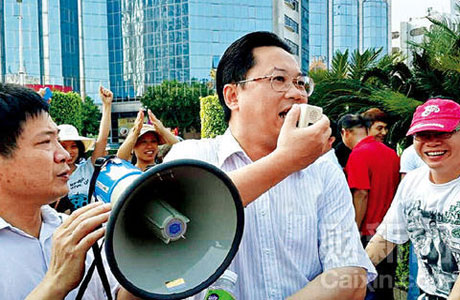
This is an interesting story about the growing democracy in China. It tells of a governmental effort to site a uranium processing facility. After the site was selected and cleared by the local bureaucracy for construction, the government undertook a mandatory "social stability assessment", to check on social acceptance for the project. During the assessment, the local community discovered it was to be a nuclear processing facility, information withheld to this point in the siting process. When they found it out, the local version of Twitter took over and mobilized local protests, which resulted in the government cancelling the project. If only it were that easy in this bastion of freedom! I like the idea of a "social stability assessment"; should be part of every EIR! -------- Original Message -------- Subject: When a Wave of Protest Swamped a Nuclear Fuel Project In China Date: Fri, 2 Aug 2013 11:36:55 -0700 From: Steve Zeltzer <lvpsf@igc.org> To: NFC NFC <Nirs@sanonofre.com> When a Wave of Protest Swamped a Nuclear Fuel Project In China http://english.caixin.com/2013-07-31/100563607.html 07.31.2013 19:59 When a Wave of Protest Swamped a Nuclear Fuel Project Local officials followed orders by checking how a proposed uranium processing facility would affect social stability, but they still ran into public opposition By staff reporters He Xin and Tian Lin A Jiangmen's deputy mayor, Wu Guojie, tells protesters the project has been canceled (Jiangmen) – In mid-July, officials in Jiangmen, a city in the southern province of Guangdong, found it impossible to stop a protest against a massive nuclear fuel project planned for the western part of the Pearl River Delta. Officials had carefully planned their every step to avoid angering the public, including a using new mechanism to evaluate the risk to social stability that a project poses, but the facility still ran into a storm of public protest. "No one would listen," an official in Jiangmen complained. This was the second time this year that a civilian nuclear project in China was canceled due to public disagreement. In February a project in Guangxi Province was halted for similar reasons. The planned 37 billion yuan uranium processing facility in Jiangmen was being built by the China National Nuclear Corp. (CNNC), a state-owned company. In the past, when CNNC was an arm of the government, it developed the country's atomic bomb, hydrogen bomb and nuclear submarines. Local officials say the uranium-processing facility was based on mature technology and vouched for by foreign and domestic experts, meaning it would have been safe to operate. By end of February, CNNC had completed a range of evaluations on issues including engineering, risks regarding earthquakes and flooding, and impact on nearby mines. Based on these reports, CNNC received approvals from the National Development and Reform Commission (NDRC) and the economic planner's Guangdong branch. CNNC already operates inland fuel-processing plants in Baotou, Inner Mongolia, and Yibin, Sichuan Province. The Jiangmen project would be the third plant on the coast to take uranium from mines overseas that CNNC had acquired. CNNC says the fuel-making process does not involve nuclear fission or fissile materials, and the yellow cake uranium fuel was so safe it could be held by hand. Clearing the Way Nuclear plants are not new to Guangdong. Heshan, a county-level city administered by Jiangmen, where the facility would have been located, is close to the four nuclear power plants operating around the Pearl River Delta. They are all owned by the Guangdong branch of state-owned China General Nuclear Power Corp. (CGN). CNNC chose the location in Guangdong due to heavy lobbying by officials from the coastal province who wanted to boost their economy. Before CNNC picked Heshan over Tianjin and the Jiangsu cities of Wuxi and Kunshan, the Heshan government had already secured the provincial government's approval. After CNNC obtained the risk assessment results, it was the Jiangmen and Heshan governments' turn to do their job: get land from local residents and evaluate the possible hazards to social stability. Since last year, a regulation issued by the State Council, China's cabinet, requires large infrastructure projects to undergo not only environmental impact and safety evaluations but also be assessed for potential to cause social disturbances. In February, the NDRC published rules requiring all domestic infrastructure projects to be assessed for the risk they pose to social stability. This is to be done after the projects receive NDRC approval but before construction starts. Land clearing for the Longwan Industrial Park, where the nuclear fuel project was to be built, went smoothly. The government sent notices to residents in four villages to relocate at the end of April. They received their compensation within two to three weeks. Critically, villagers were told that the land would be used to build an industrial park. The next step was the social stability assessment. The Heshan government had some difficulty finding a consulting firm to do it because the rules were new and unfamiliar. The government settled on Jiangmen Nuocheng Engineering Consulting Co., the only NDRC-certified engineering consultancy in Heshan, which subcontracted a study from a firm in Guangzhou. Then Nuocheng assembled experts to comment on the study. It surveyed and interviewed residents. This sounds good, but there is a built-in problem with the arrangement. An employee at Nuocheng told Caixin that if the risk is assessed as high, regulators will halt the project. The project operator usually pays for the assessment, and few consultants want to kill their client's project, the employee said. The Nuocheng report identified six major risk areas and corresponding remedies, and posted the report along with findings and recommendations on the Jiangmen government's website on July 4. The public was given 10 days to comment. Nuocheng said this period was based on prior projects. Heshan officials, however, did not anticipate the outpouring of public resistance that ensued. The Tide Rolls In News of the project spread quickly on Sina Weibo, the country's version of Twitter. Residents expressed concern, then alarm. Villagers were surprised that the "industrial park" they had been told about was going to process radioactive fuel. Area residents complained that the government had signed a deal with CNNC before even seeking their input. Five days later, color fliers appeared under villagers' doors. The fliers included a news article that expressed doubts about the project and pictures of victims of the 1986 Chernobyl nuclear accident. Villagers were asked who would want to work in Heshan or buy local products after the plant was built. On July 12, more than 1,000 protesters descended on the offices of the Heshan city government, including many people from nearby cities, to oppose building the project. Heshan and Jiangmen officials hastily called a press conference and promised to run more TV programs to educate the public. They also arranged for journalists from mainland media and from Macau and Hong Kong to tour CNNC's facilities in Yibin. The Heshan government also announced a 10-day extension to the public comment period. Deng Weidong, director of Heshan's development and reform commission, said at the time that the city fully complied with the NDRC rules concerning the social stability risk assessment. A day after the demonstration, however, a notice that the project had been canceled was posted on the Jiangmen government's website. It said the decision was made out of respect for the wishes of the people. Privately, Heshan and Jiangmen officials lament the loss of a project that would have been a major generator of tax revenue. They had a litany of reasons for what went wrong. Some blamed old bureaucratic habits for alienating the public. Another pointed to the fact officials and party committees lacked Sina Weibo accounts that could have been used to get their side of the story across. Some were at loss to explain what the scope of the social stability assessment should be. Meanwhile, nuclear industry insiders said the cancellation raised fresh concerns about issues related to educating the public and the different interest groups involved. Another insider says the solutions to these difficulties might be found in Taiwan, where parties are directly compensated, and France, where the nuclear power industry provides direct benefits to the local community. In China, however, citizens must wait for the local government to convert tax revenues from the nuclear power into tangible benefits, the source said. Officials in Heshan tried to explain the benefits to come, but, as one Heshan official said: "The more we explained, the more people believed we were deceiving them."